

Documentation Index
Fetch the complete documentation index at: https://docs.canton.network/llms.txt
Use this file to discover all available pages before exploring further.
Functional programming 101
In this chapter, you will learn more about expressing complex logic in a functional language like Daml. Specifically, you’ll learn about- Function signatures and functions
- Advanced control flow (
if...else, folds, recursion,when)
compose and dependencies projects set up, and want to look back at the code, please follow the setup instructions in dependencies to get hold of the code for this chapter.
There is a project template
daml-intro-functional-101 for this chapter, but it only contains a single source file with the code snippets embedded in this section.The Haskell connection
The previous chapters of this introduction to Daml have mostly covered the structure of templates, and their connection to the Daml Ledger Model. The logic of what happens within thedo blocks of choices has been kept relatively simple. In this chapter, we will dive deeper into Daml’s expression language, the part that allows you to write logic inside those do blocks. But we can only scratch the surface here. Daml borrows a lot of its language from Haskell. If you want to dive deeper, or learn about specific aspects of the language you can refer to standard literature on Haskell. Some recommendations:
- Finding Success and Failure in Haskell (Julie Moronuki, Chris Martin)
- Haskell Programming from first principles (Christopher Allen, Julie Moronuki)
- Learn You a Haskell for Great Good! (Miran Lipovača)
- Programming in Haskell (Graham Hutton)
- Real World Haskell (Bryan O’Sullivan, Don Stewart, John Goerzen)
- Haskell is a lazy language, which allows you to write things like
head [1..], meaning “take the first element of an infinite list”. Daml by contrast is strict. Expressions are fully evaluated, which means it is not possible to work with infinite data structures. - Daml has a
withsyntax for records and a dot syntax for record field access, neither of which is present in Haskell. However, Daml supports Haskell’s curly brace record notation. - Daml has a number of Haskell compiler extensions active by default.
- Daml doesn’t support all features of Haskell’s type system. For example, there are no existential types or GADTs.
- Actions are called Monads in Haskell.
Functions
Indata you learnt about one half of Daml’s type system: Data types. It’s now time to learn about the other, which are Function types. Function types in Daml can be spotted by looking for -> which can be read as “maps to”.
For example, the function signature Int -> Int maps an integer to another integer. There are many such functions, but one would be:
increment it could have been omitted. Similarly, we could define a function add without a declaration:
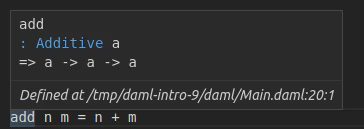
- We have more than one
->. - We have a type parameter
awith a constraintAdditive a.
Function application
Let’s start by looking at the right hand parta -> a -> a. The -> is right associative, meaning a -> a -> a is equivalent to a -> (a -> a). Using the “maps to” way of reading ->, we get “a maps to a function that maps a to a”.
And this is indeed what happens. We can define a different version of increment by partially applying add:
Int -> Int again. It can do so because of the literal 1 : Int.
So if we have a function f : a -> b -> c -> d and a value valA : a, we get f valA : b -> c -> d, i.e. we can apply the function argument by argument. If we also had valB : b, we would have f valA valB : c -> d. What this tells you is that function application is left associative: f valA valB == (f valA) valB.
Infix functions
Nowadd is clearly just an alias for +, but what is +? + is just a function. It’s only special because it starts with a symbol. Functions that start with a symbol are infix by default which means they can be written between two arguments. That’s why we can write 1 + 2 rather than + 1 2. The rules for converting between normal and infix functions are simple. Wrap an infix function in parentheses to use it as a normal function (i.e. prefix), and wrap a normal function in backticks to make it infix:
add more succinctly as the alias that it is:
Associativity and Precedence
When dealing with multiple infix operators, precedence determines how the Daml compiler should parse an expression. For example, for the expressionx + y * z, because * has a higher precedence than +, the expression is parsed as x + (y * z) instead of (x + y) * z. When dealing with infix operators with the same precedence, associativity determines how the Daml compiler should parse an expression. For example, because + and - are left-associative, the expression x + y - z is parsed as (x + y) - z instead of x + (y - z). For built-in operators this has been predefined, for user-defined operators, it must be user-defined. See the Daml language reference on fixity, associativity and precedence for details.
Type constraints
TheAdditive a => part of the signature of add is a type constraint on the type parameter a. Additive here is a typeclass. You already met typeclasses like Eq and Show in data. The Additive typeclass says that you can add a thing, i.e. there is a function (+) : a -> a -> a. Now the way to read the full signature of add is “Given that a has an instance for the Additive typeclass, a maps to a function which maps a to a”.
Typeclasses in Daml are a bit like interfaces in other languages. To be able to add two things using the + function, those things need to “expose” (have an instance for) the Additive interface (typeclass).
Unlike interfaces, typeclasses can have multiple type parameters. A good example, which also demonstrates the use of multiple constraints at the same time, is the signature of the exercise function:
t is the type of a template, and that t has a choice c with return type r, the exercise function maps a ContractId for a contract of type t to a function that takes the choice arguments of type c and returns an Update resulting in type r.
That’s quite a mouthful, and does require one to know what meaning the typeclass Choice gives to parameters t c and r, but in many cases, that’s obvious from the context or names of typeclasses and variables.
Using single letters, while common, is not mandatory. The above may be made a little bit clearer by expanding the type parameter names, at the cost of making the code a bit longer:
Pattern matching in arguments
You met pattern matching indata, using case expressions which is one way of pattern matching. However, it can also be convenient to do the pattern matching at the level of function arguments. Think about implementing the function uncurry:
uncurry takes a function with two arguments (or more, since c could be a function), and turns it into a function from a 2-tuple to c. Here are three ways of implementing it, using tuple accessors, case pattern matching, and function pattern matching:
case you can also do at the function level, and the compiler helpfully warns you if you did not cover all cases, which is called “non-exhaustive”.
fromSome here, is called a partial function. fromSome None will cause a runtime error.
We can use function level pattern matching together with a feature called Record Wildcards to write the function issueAsset in dependencies:
.. in the pattern match here means bind all fields from the given record to local variables, so we have local variables issuer, owner, etc.
The .. in the second to last line means fill all fields of the new record using local variables of the matching names, in this case (per the definition of Issue_Asset), symbol and quantity, taken from the asset argument to the function. In other words, this is equivalent to:
asset@(Asset with ..) binds asset to the entire record, while also binding all of the fields of asset to local variables.
Functions everywhere
You have probably already guessed it: Anywhere you can put a value in Daml you can also put a function. Even inside data types:let clause or similar. Good examples of this are the validate and transfer functions defined locally in the Trade_Settle choice of the model from dependencies:
Bear in mind that functions are not serializable, so you can’t use them inside template arguments, as choice inputs, or as choice outputs. They also don’t have instances of the
Eq or Show typeclasses which one would commonly want on data types.mapA and mapA_ functions loop through the lists of assets and approvals, and apply the functions validate and transfer to each element of those lists, performing the resulting Update action in the process. We’ll look at that more closely under loops below.
Lambdas
Daml supports inline functions, called “lambda”s. They are defined using the(\x y z -> ...) syntax. For example, a lambda version of increment would be (\n -> n + 1).
Control flow
In this section, we will cover branches and loops, and look at a few common patterns of how to translate procedural code into functional code.Branches
Untilcompose the only real kind of control flow introduced has been case, which is a powerful tool for branching.
If-else expression
constraints also showed a seemingly self-explanatory if ... else expression, but didn’t explain it further. Let’s implement the function boolToInt : Bool -> Int which in typical fashion maps True to 1 and False to 0. Here is an implementation using case:
if ... else expressions are equivalent to case expressions, but can be easier to read.
Control flow as expressions
case and if ... else expressions really are control flow in the sense that they short-circuit:
boom is an error.
While providing proper control flow, case and if ... else expressions do result in a value when evaluated. You can actually see that in the function definitions above. Since each of the functions is defined just as a case or if ... else expression, the value of the evaluated function is just the value of the case or if ... else expression. Values have a type: the if ... else expression in boolToInt2 has type Int as that is what the function returns; similarly, the case expression in doError has type Bool. To be able to give such expressions an unambiguous type, each branch needs to have the same type. The below function does not compile as one branch tries to return an Int and the other a Text:
Either type:
Branches in actions
The most common case where this becomes important is insidedo blocks. Say we want to create a contract of one type in one case, and of another type in another case. Let’s say we have two template types and want to write a function that creates an S if a condition is met, and a T otherwise.
if ... else, but it won’t typecheck if each branch returns a different type:
- Use the
Eithertrick from above. - Get rid of the return types.
DA.Action to get rid of the return type: void : Functor f => f a -> f ().
void also helps express control flow of the type “Create a T only if a condition is met.
else clause of the same type (). This pattern is so common, it’s encapsulated in the standard library function DA.Action.when : (Applicative f) => Bool -> f () -> f ().
when looking like a simple function, the compiler does some magic so that it short-circuits evaluation just like if ... else and case. The following noop function is a no-op (i.e. “does nothing”), not an error as one might otherwise expect:
case, if ... else, void and when, you can express all branching. However, one additional feature you may want to learn is guards. They are not covered here, but can help avoid deeply nested if ... else blocks. Here’s just one example. The Haskell sources at the beginning of the chapter cover this topic in more depth.
Loops
Other than branching, the most common form of control flow is looping. Looping is usually used to iteratively modify some state. We’ll use JavaScript in this section to illustrate the procedural way of doing things.result in the former, state in the latter. Values in Daml are immutable, so it needs to work differently. In Daml we will do this with folds and recursion.
Folds
Folds correspond to looping with an explicit iterator:for and forEach loops in procedural languages. The most common iterator is a list, as is the case in the sum function above. For such cases, Daml has the foldl function. The l stands for “left” and means the list is processed from the left. There is also a corresponding foldr which processes from the right.
b is the state, a is an item. foldls first argument is a function which takes a state and an item, and returns a new state. That’s the equivalent of the inner block of the forEach. It then takes a state, which is the initial state, and a list of items, which is the iterator. The result is again a state. The sum function above can be translated to Daml almost instantly with those correspondences in mind:
(+) with a lambda (\result i -> result + i) which makes the correspondence to result += i from the JavaScript clearer.
Almost all loops with explicit iterators can be translated to folds, though we have to take a bit of care with performance when it comes to translating for loops:
for into a forEach is easy if you can get your hands on an array containing values [0..(l-1)]. And that’s how you do it in Daml, using ranges. [0..(l-1)] is shorthand for enumFromTo 0 (l-1), which returns the list you’d expect.
Daml also has an operator (!!) : [a] -> Int -> a which returns an element in a list. You may now be tempted to write sumArrs like this:
(!!) too slow for this kind of iteration. A better approach in Daml is to get rid of the i altogether and instead merge the lists first using the zip function, and then iterate over the “zipped” up lists:
zip : [a] -> [b] -> [(a, b)] takes two lists, and merges them into a single list where the first element is the 2-tuple containing the first element of the two input lists, and so on. It drops any left-over elements of the longer list, thus making the min logic unnecessary.
Maps
In effect, the lambda passed tofoldl only “wants” to act on a single element of the (zipped-up) input list, but still has to manage the concatenation of the whole state. Acting on each element separately is a common-enough pattern that there is a specialized function for it: map : (a -> b) -> [a] -> [b]. Using it, we can rewrite sumArr to:
map if the result has the same shape as the input and you don’t need to carry state from one iteration to the next. Use folds if you need to accumulate state in any way.
Recursion
If there is no explicit iterator, you can use recursion. Let’s try to write a function that reverses a list, for example. We want to avoid(!!) so there is no sensible iterator here. Instead, we use recursion:
reverseWorker a local definition inside reverse, but Daml only supports recursion for top-level functions so the recursive part recurseWorker has to be its own top-level function.
Folds and maps in action contexts
The folds andmap function above are pure in the sense introduced in constraints: The functions used to map or process items have no side effects. If you have looked at the dependencies models, you’ll have noticed mapA, mapA_, and forA, which seem to serve a similar role but within Actions . A good example is the mapA call in the testMultiTrade script:
[Relationship]) and a function setupRelationship : Relationship -> Script (ContractId AssetHolder). We want the AssetHolder contracts for those relationships, i.e. something of type [ContractId AssetHolder]. Using the map function almost gets us there, but map setupRelationship rels would have type [Update (ContractId AssetHolder)]. This is a list of Update actions, each resulting in a ContractId AssetHolder. What we need is an Update action resulting in a [ContractId AssetHolder]. The list and Update are nested the wrong way around for our purposes.
Intuitively, it’s clear how to fix this: we want the compound action consisting of performing each of the actions in the list in turn. There’s a function for that: sequence : : Applicative m => [m a] -> m [a]. It implements that intuition and allows us to “take the Update out of the list”, so to speak. So we could write sequence (map setupRelationship rels). This is so common that it’s encapsulated in the mapA function, a possible implementation of which is
A in mapA stands for “Action”, and you’ll find that many functions that have something to do with “looping” have an A equivalent. The most fundamental of all of these is foldlA : Action m => (b -> a -> m b) -> b -> [a] -> m b, a left fold with side effects. Here the inner function has a side-effect indicated by the m so the end result m b also has a side effect: the sum of all the side effects of the inner function.
To improve your familiarity with these concepts, try implementing foldlA in terms of foldl, as well as sequence and mapA in terms of foldlA. Here is one set of possible implementations:
forA is just mapA with its arguments reversed. This is useful for readability if the list of items is already in a variable, but the function is a lengthy lambda.
mapA_, not mapA. The underscore indicates that the result is not used, so mapA_ fn xs fn == void (mapA fn xs). The Daml Linter will alert you if you could use mapA_ instead of mapA, and similarly for forA_.
Next up
You now know the basics of functions and control flow, both in pure and Action contexts. Thedependencies example shows just how much can be done with just the tools you have encountered here, but there are many more tools at your disposal in the Daml standard library. It provides functions and typeclasses for many common circumstances and in stdlib, you’ll get an overview of the library and learn how to search and browse it.