Informee
A party can take different roles in Daml templates and choices; the party can be declared assignatory, choice controller, or contract or choice observer.
For a contract, a party is a stakeholder if it is a signatory or contract observer of the contract.
-
Every contract and choice
observershould observe changes to the contract (creation or archival) and exercises of a choice, respectively, as the name suggests. -
A
signatoryis bound by a contract and thus has a stake in it; they should learn when the contract is created or used. -
An actor of an Exercise, which is the
controllerof the choice, has a stake in the action and should therefore see the exercise; they may not have a stake in the contract though.
For example, the informees of a Create node are the stakeholders of the created contract, that is, the signatories and observers.
For consuming Exercise node, the informees consist of the stakeholders of the consumed contract, the action’s actors and choice observers.
As a design decision, a contract observer is not informed about non-consuming Exercise and Fetch actions,
unless they are explicitly among the actors or choice observers.
This is because such actions do not change the state of the contract itself.
Templates can declare
preconsuming and postconsuming choices.
Daml compiles such choices to a non-consuming choice whose first or last consequence exercises the Archive choice on the template.
Accordingly, contract observers are only informees of the Archive subaction, but not of the main Exercise action itself.AcceptAndSettle action have the informees shown in the blue hexagons of the next figure.
For example, Alice is an informee of the root node ① because she is a signatory of the input contract #3, and Bob is an informee because he is the actor of the choice.
Similarly, Bank 2 and Bob are informees of the Fetch node ③ because Bank 2 is a signatory of the input contract #2 and Bob is the actor.
Had Bob not been the actor, he would not be an informee because contract observers are not automatically informees of non-consuming Exercises and Fetches.

Witness
A single node can be part of multiple actions. For example, the diagram below extends the subaction diagram with the informees shown in the top right corner of the borderless box for each subaction. Here, the Create node ③ is part of three subactions, namely those rooted at nodes ①, ②, and ③. Accordingly, this Create node is shown to the informees of all these actions, even if they are not informees of the node itself. Those parties are called witnesses. Formally, for a given transaction tx, the witnesses of a node in tx are the union of the informees of all subactions of tx that contain the node. In particular, every informee of the node is also a witness. The diagram shows the witnesses of a subaction in purple on its root action. For node ③, the witnesses are Alice, Bob, and Bank 1, because Bob is an informee of ① and ③; Bank 1 is an informee of ② and ③; and Alice is an informee of ① and ②.
Projection
Informees should see the changes they are entitled to see, but this does not mean that they are entitled to see the entirety of any transaction that includes such a change. This is made precise through projections of a transaction, which define the view that a group of parties gets on a transaction. Intuitively, given a transaction within a commit, a group of parties sees only the subtransaction consisting of all actions on contracts whose informees include at least one of the parties. Equivalently, the group of parties sees only those nodes whose witnesses include at least one of the parties. Thus, privacy is obtained on the subtransaction level. This section first defines projections for transactions and then for ledgers.Transaction projection
The next diagram gives an example for a transaction with theAcceptAndSettle Exercise action as the only root action, whose informees are shown in the diagrams above.

AcceptAndSettle choice on Alice’s ProposeSimpleDvP contract,
the projection to either Alice or Bob or both consists of the whole Exercise action.
As an action consists of the whole subtree underneath its root node,
Alice and Bob each see all the nodes they are witnesses of.
For example, Alice’s projection includes the Fetch subaction, Bob’s Transfer exercise of on #2, and the creation of Bob’s SimpleAsset contract #5.
Similarly, Bob’s projection includes Alice’s Transfer Exercise on #1 and the creation of Alice’s SimpleAsset contract #6.
In contrast, the banks are not informees of the root action.
In fact, Bank 1 appears as an informee only in the Transfer Exercise action on #1 and its subaction, the creation of Bob’s new asset #5.
Accordingly, the projection to Bank 1 consists of just this Exercise action.
Bank 2 appears as an informee of two unrelated actions in the tree: the Fetch action and the Transfer Exercise action on #2.
The projection to Bank 2 therefore consists of a transaction with these two actions as root actions.
This shows that projection can turn a single root action into a list of subactions.
Note the privacy implications of the banks’ projections.
While each bank learns that a
Transfer has occurred from Alice to Bob or vice versa,
each bank does not learn anything about why the transfer occurred.
In particular, Bank 2 does not learn what happens between the Fetch and the Exercise on contract #2.
In practice, this means that Bank 1 and Bank 2 do not learn what Alice and Bob is exchanging their asset for,
providing privacy to Alice and Bob with respect to the banks.Definition: projectionThe projection of a transaction for a set P of parties is the
subtransaction obtained by doing the following for each root action act of the transaciton.
- If P contains at least one of the informees of act, keep act as-is, including its consequences.
- Else, if act has consequences, replace act by the projection (for P) of its consequences, which might be empty.
- Else, drop act including its consequences.
Ledger projection
Finally, the projection of a ledger l for a set P of parties is a DAG of updates obtained as follows:- Project the transaction of each update in l for P, but retain the update ID.
- Remove updates with empty transactions from the result.
Transfer choice on contract #1.
Projecting the ledger of the complete DvP example yields the following projections for each party.

-
Alice sees all of the first, third, and fourth commit
as she is an informee of all root actions.
In contrast, Alice does not see anything of the second commit,
as she is not a stakeholder of Bob’s
SimpleAssetof 1 USD. This transaction is not present in Alice’s projection at all. Yet, the output of this transaction (contract #2) is used in the last commit of Alice’s projection. Accordingly, contract #2 is shown as an input to the left, outside of the ledger. This effect is discussed below under retroactive divulgence. - Bob’s projection is analogous to Alice’s: He sees everything of the second, third, and fourth commit, but nothing of the first commit and instead merely contract #1 as an input.
-
Banks 1 and 2 only see the commits in which they create their
SimpleAssetand theTransferExercises on them. Additionally, Bank 2 sees the Fetch of theSimpleAssetin the last commit, as already discussed above for transaction projections.
TX 3.
They can therefore infer that their projections have happened in the same atomic transaction even though their projections do not share a single node.
A user of a Participant Node can request the Ledger projection for the user’s parties via the
updates tree stream.
Divulgence: When non-stakeholders see contracts
The guiding principle for the privacy model of Canton ledgers is that contracts should only be shown to their stakeholders. However, ledger projections can cause contracts to become visible to other parties as well. Showing contracts to non-stakeholders through ledger projections is called divulgence. Divulgence is a deliberate choice in the design of Canton Ledgers and comes in two forms:-
Immediate divulgence refers to witnesses seeing contract creations they are not an informee of.
In the example of ledger projections of the DvP,
Bob is a witness of the Create action for Alice’s new
SimpleAsset(contract #6), but not an informee. Conceptually, at the instant where Bob exercises theTransferchoice, he also gains a temporary stake in the outcome of theTransfer, namely to see that the asset now belongs to Alice. In general, there is no point in hiding the consequences of an action. Bob could anyway compute the consequences of the actions it is an informee of, because Daml is deterministic. -
Retroactive divulgence refers to an input contract being shown to the non-informee witnesses of a node using this contract.
For example, the Fetch on Bob’s
SimpleAsset(contract #2) is visible to Alice and Alice’s projection therefore references this contract as an input even though the Create action for #2 is not part of Alice’s projection. Retroactive divulgence enables Alice to validate the transactions in her projection (see Consistency for ledger integrity). That is, Alice can check that Bob does allocate a suitableSimpleAssetaccording to what she specified in her proposal. Retroactive divulgence does not make Alice a witness of the Create action for Bob’sSimpleAsset(contract #2), because an input contract is not the same as its Create action. In the diagrams, this distinction is visualized via the dashed border for input contracts and them being placed to the left.
Disclosure: When non-stakeholders use contracts
Divulgence from the previous section refers to parties learning about contracts they are not a stakeholder of. Disclosure is about such parties using contracts in their own transactions. Recall from the running example that Bob usessubmit with a disclosure for the exercising Settle choice.
This is because Bob (and its Participant Node) in general does not know about the SimpleAsset contract #2
that Alice has allocated to the proposal.
Disclosure means that Alice tells Bob via an off-ledger communication channel about this contract.
In the Daml script running example, the script itself is the communication channel.
In real-world contexts, Alice would offer an API for Bob to retrieve the relevant data.
It is a design decision that immediate divulgence does not entail disclosure for subsequent transactions.
For example, after the DvP has been settled, Alice creates another DvP proposal for Bob to swap the two assets again:
SimpleAsset even though Bob is a witness of the creation of Alice’s SimpleAsset.
A plain submit without disclosure does not work.
The motivation for not using immediate divulgence implicitly for disclosure is that it leads to brittle workflows.
The problem is that the non-stakeholders only learn about the creation of the contract,
but not about subsequent actions on the contract like archivals.
Accordingly, there is no general rule as to how long the non-stakeholder should long to keep the contract around.
Keeping it for too long will waste storage; and keeping it too short may break certain applications.
Instead, this rule forces the application to explicitly design for disclosure even for divulged contracts
and come up with a suitable application-specific rule.
An alternative approach to disclosure is to replace the original SimpleAsset contract by one
on which the Bob becomes a contract observer.
This requires extending the contract model with a (consuming) exercise action on the SimpleAsset
that creates a new SimpleAsset, with observers of Alice’s choice.
In addition to the increase in actions on the Ledger,
the two approaches differ in in who learns about the parties that are informed about the contract:
-
If Alice discloses her
SimpleAssetto Bob via an off-ledger channel, only Alice and Bob need to know about this disclosure. So when Alice discloses the same contract to Charlie, Charlie does not need to know that Alice had already shown the contract to Bob, and Bob does not need to know that Alice is disclosing it to Charlie. - In contrast, when Alice adds Bob as a contract observer and then subsequently adds Charlie as another observer, Bob as a contract observer is notified about the archival and the creation. Similarly, Charlie learns that Bob is an observer on the contract, too. That is, all stakeholders learn about each other. This created a privacy problem when Alice actually does not want that Bob and Charlie know of each other.
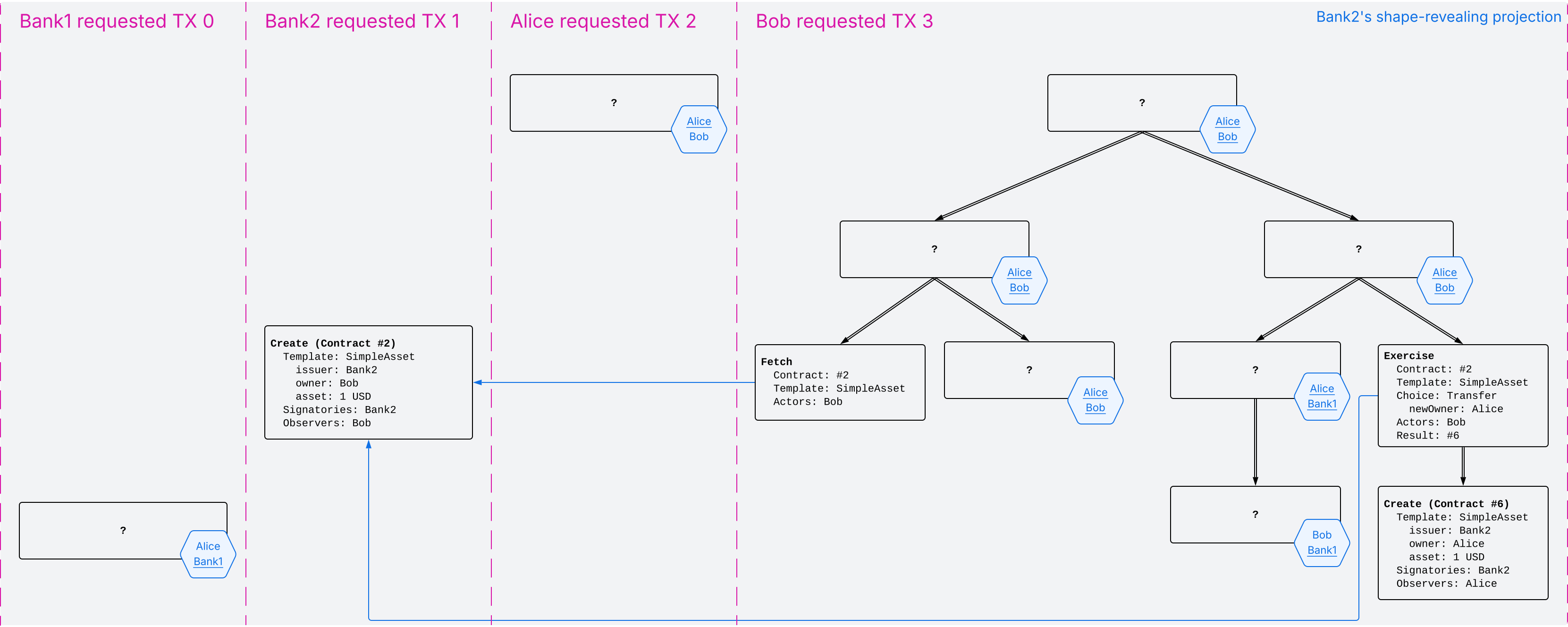
Shape-revealing projection
As explained above, projections define the pieces of the ledger that a set of parties can see, and thereby also the pieces that they can not see. For example, the above transaction projection for Bank 2 omits what happens between the Fetch and the Exercise on contract #2 and thereby implies that Bank 2 has no way of finding this out on their own. In practice, this strong privacy statement assumes that Bank 2 interacts with the Ledger only via the Ledger API of their Participant Nodes. In contrast, if Bank 2 observes the communication patterns between the Participant Nodes, Bank 2 might be able to deduce that Bank 1 was also involved in this transaction. Similarly, if Bank 2 can inspect the on-wire data of such communication, as is for example possible to some extent on the Global Synchronizer, then Bank 2 can infer some information about the shape of the original transaction and the parties involved, beyond what is visible in the projection. This is because the synchronizer needs this shape information for its two-phase commit protocol. This section defines the shape that overapproximate the information that can leak via messages exchanged via the synchronizer. Overapproximation here means that a curious party may not be able to fully reconstruct the shape of a transaction on the ledger, for example due to optimizations in the synchronization protocol. The synchronization protocol uses a notion of the required confirmers for a node, which are a subset of the informees. The required confirmers are therefore part of the shape and defined as follows.Definition: required confirmersThe required confirmers for a Create node are the signatories and for an Exercise or Fetch node are the signatories and actors.
Definition: node shapeThe shape of a node consists of the following pieces of information:
- The informees of the node.
- The size of the encoding of the node contents and the input contract, if any.
- The required confirmers for the node.
Definition: shape-revealing projectionThe shape-revealing projection of a transaction for a set P of parties is obtained as follows for each root action act of the transaction:
- If P contains at least one of the informees of act, keep act as-is, including its consequences.
- Else, replace the node of act with its shape and the shape-revealing projection of the consequences of act becomes the children of the node shape.