

Canton Network Applications
Canton Network applications are used to operate business processes spanning multiple organizations or business entities. Use the following documentation to build Canton Network applications and get them featured on the Canton Network:- Review the summary of the Canton Network tokenomics.
- Learn to build Canton Network applications from the tutorials, how-tos, explanations, and reference documentation at Choose Your Path
- Browse the currently featured apps: https://sync.global/featured-apps/
- Request your app to be featured: https://sync.global/featured-app-request/
- These requests are published on the Tokenomics mailing list. Browse that list for inspiration and to see what other apps are being built.
- Join the app development discussion in the #gsf-global-synchronizer-appdev Slack channel by sending a request to operations@sync.global for your Slack organization to be added to the channel.
RPC APIs Overview
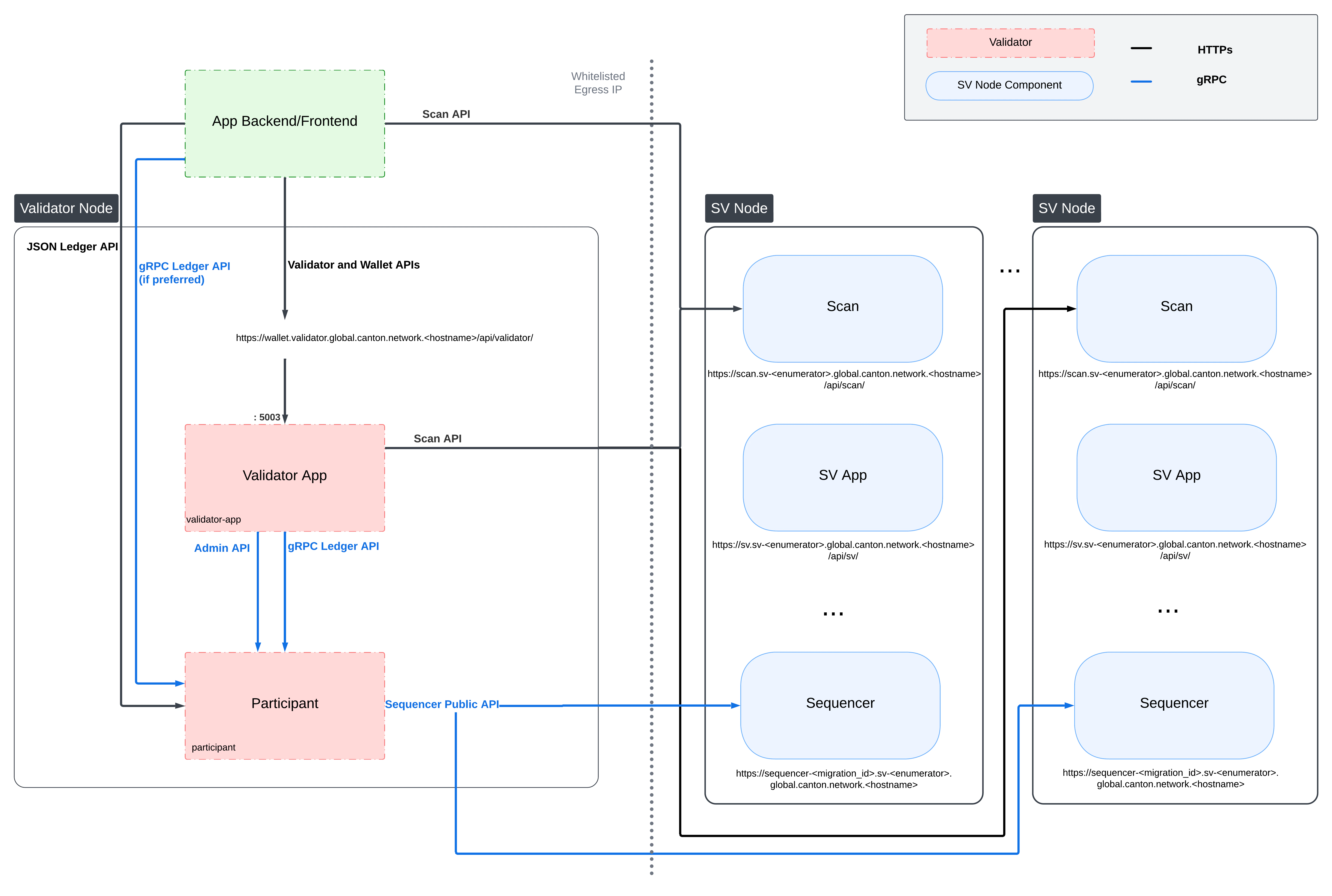
When building an application for the Canton Network, you will typically integrate with some of the HTTP or gRPC APIs provided by the Global Synchronizer and Validator Nodes. Use the guidance below to learn which ones to use and how to use them.- Use the
app_dev_ledger_apito access the view of the ledger as seen by the parties hosted on a Validator Node and submit transaction to the ledger. - Use the app_dev_scan_api to access the view of the ledger and its infrastructure as seen by all SV Nodes. Note that this view is the one visible to the DSO party and does not include any of the data that is private to the parties hosted on Validator Nodes. Use the
app_dev_ledger_apito access the data of parties hosted on the Validator Node. - Use the app_dev_validator_api to access higher-level functionality provided by the Splice Validator App running alongside the Canton Participant node in a Validator Node.
Splice Daml APIs Overview
Splice implements several decentralized applications whose on-ledger state and workflows are implemented in Daml. An Interface defined in Daml code is a public API that you should develop against because they are stable. These public APIs are used in interoperability standards, like the Canton Network Token Standard. Use these Daml APIs to minimize the coupling between your application’s Daml code and the Daml code of your dependencies. For example, theInterfaces in the Splice implementation loosely couple an application with the implementation so that a Splice upgrade avoids forcing a corresponding upgrade of an application’s Daml code.
See the app_dev_daml_api for an overview of the Daml APIs defined in Splice and their purpose.
Splice Daml Models Overview
A Daml model’s Templates and Choices are considered internal implementation details. For example, the Canton Network Token Standard is the public API for working with tokens, including Canton Coin. The Canton Network Token Standard implementation operates on top of the AmuletRules_Transfer choice (this provides backwards compatibility). It is worthwhile and recommended to study these implementation details because you can learn a lot by examination. Use the following resources to learn how to interact with the Daml models state and workflows.- Learn how to read and write Daml code from: /appdev/get-started/choose-your-path
- Learn about the Daml packages that are part of Splice and their data models and workflows from app_dev_daml_models.